By the end of this post, you’ll be able to look at a task and decide — before you write a single line of prompt text — whether it belongs in one request or needs to be split into a sequence of smaller ones. That decision determines your latency budget, your error surface, and how much of the process you can debug when something goes wrong.
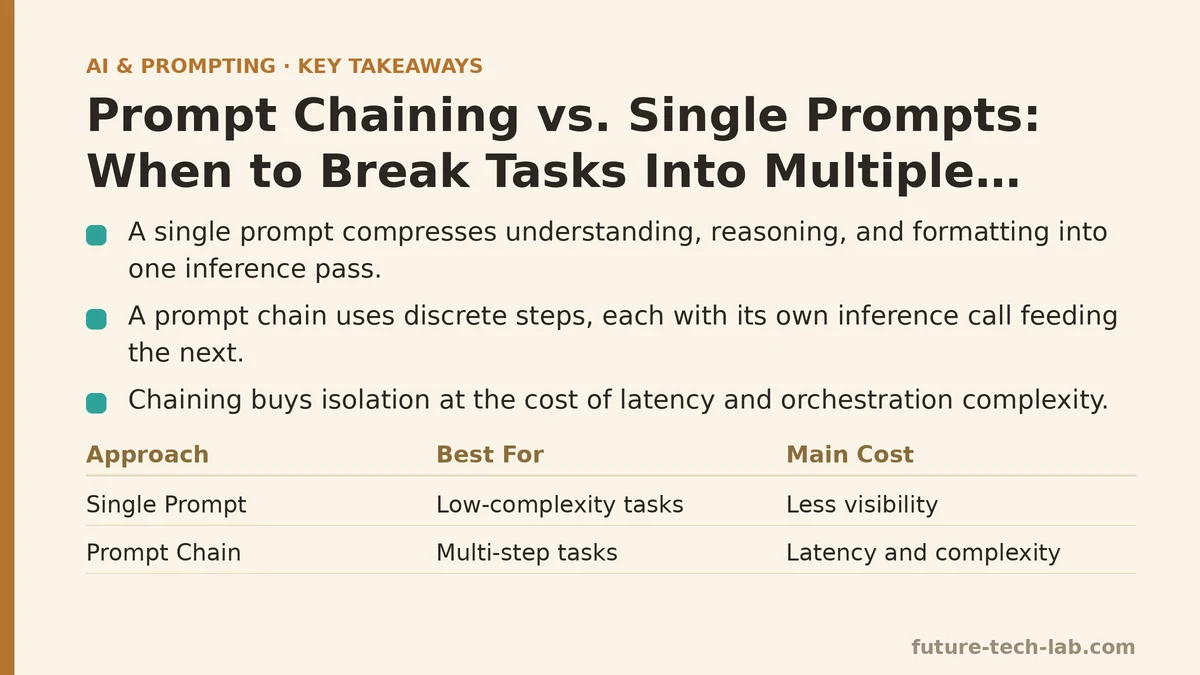
A single prompt asks a model to compress an entire task — understanding, reasoning, formatting — into one inference pass. A prompt chain breaks that same task into discrete steps, each with its own inference call, where the output of one becomes the input to the next. Both are legitimate architectures. Neither is strictly better. The mistake most people make is picking one out of habit rather than matching it to the shape of the problem.
The core tradeoff, stated plainly
Every additional step in a chain buys you isolation at the cost of latency and orchestration complexity. A single prompt buys you speed and simplicity at the cost of visibility into where things break.
Think of it the way you’d think about a monolith versus a set of microservices. A monolith is faster to call and easier to reason about when the logic is simple. Split it into services and you gain the ability to test, retry, and scale each piece independently — but you’ve also introduced network hops, serialization, and more places for a failure to originate. Prompt chains carry the same cost structure, just with inference calls standing in for network calls.
Beginner approach: one prompt, one shot
What it looks like
At the beginner level, the instinct is to write a single, increasingly detailed prompt and hope the model handles every sub-task inside it. “Summarize this document, extract the key dates, translate the summary into French, and format the whole thing as a table.” One call, one response, done.
Why this works up to a point
For low-complexity tasks, this is the correct choice, not just the easy one. If the task has one clear objective and a small number of constraints, splitting it into multiple calls adds latency and cost without buying you anything. Asking a model to “rewrite this paragraph in a more formal tone” doesn’t need a chain — there’s no intermediate artifact worth inspecting, and the failure modes are narrow enough to catch in one pass.
Where it breaks down
The single-prompt approach degrades in a specific, predictable way as you stack more sub-tasks into it: the model starts trading depth on each sub-task for coverage across all of them. Ask for a summary, a translation, and a table in one shot, and you’ll frequently get a mediocre summary, a slightly-off translation of that already-compressed summary, and a table that mangles the formatting because the instruction was buried three sentences from the end. This isn’t a fluke — it’s the model allocating a fixed amount of generation capacity across a growing number of instructions, and something has to give.
The other beginner failure mode is diagnostic: when a single dense prompt produces a bad output, you often can’t tell which sub-task went wrong without picking the output apart manually. Did the translation fail, or was the summary bad to begin with? A single prompt gives you no checkpoint to inspect.
Advanced approach: chaining for isolation and control
What it looks like
At the advanced level, you decompose the task into steps where each step has exactly one job, and the output of each step is a well-defined input to the next.
Take the same example: summarize, extract dates, translate, format as a table. Chained, that becomes four calls:
- Summarize the source document.
- Extract dates from the original document (not the summary — more on that below).
- Translate the summary into French.
- Format the summary, dates, and translation into a table.
Each step gets a focused prompt, a narrower context, and a single success criterion you can check before moving on.
Why this is worth the extra calls
Chaining earns its cost in three specific ways:
- Error isolation. If the output is wrong, you know which step produced the bad artifact, because you have the intermediate output in hand. You can log it, diff it against expectations, and fix that one prompt without touching the rest of the pipeline.
- Reduced compounding error. Notice that date extraction runs against the original document, not the summary. That’s deliberate — summarization is lossy by design, and if you extract dates from an already-compressed summary, you’re extracting from data that’s already lost precision. Chaining lets you branch off the original source for tasks that need it, instead of forcing everything through a single degraded intermediate.
- Prompt specialization. A prompt whose only job is “extract every date mentioned in this text, in ISO 8601 format” can be short, unambiguous, and heavily constrained. Try to fold that same instruction into a four-part mega-prompt and it competes for attention with three other unrelated instructions.
What it costs you
None of this is free. Four inference calls instead of one means four times the round-trip latency at minimum, and more in practice once you account for the orchestration logic gluing the calls together — passing outputs forward, handling a failure at step two without silently corrupting step three, and deciding what “success” means at each checkpoint. If you’re building this into a product rather than running it manually, you’re also now paying for infrastructure: a queue, a state store for intermediate outputs, retry logic per step. For a one-off task you’ll run twice, that overhead isn’t worth building.
A decision framework: which one does your task need?
Ask these questions in order. The first one that gives you a clear “yes” tells you which architecture to use.
Does the task have more than two independent sub-goals? If you’re asking for one thing — a summary, a rewrite, a classification — a single prompt is almost always sufficient. Once you’re stacking three or more distinct objectives into one request, each additional objective erodes the quality of the others.
Does a later step depend on a cleaned or transformed version of an earlier step’s output, rather than the raw input? If step two needs step one’s output as its actual input — not just as context, but as the thing it operates on — you have a real dependency chain, and forcing it into one prompt means the model has to hold and transform an intermediate result silently, in its own head, with no way for you to verify it did so correctly.
Do you need to debug or audit any individual stage? If this is a workflow you’ll run repeatedly, or one where correctness matters enough that you need to know exactly which stage failed, the visibility a chain provides outweighs its latency cost.
Is latency the dominant constraint? If you’re building something interactive — a chat interface where the user is watching a spinner — every extra inference call is directly perceptible. In that context, a slightly worse single-prompt output that returns in 800ms can be the better product decision than a better four-step output that takes four seconds.
If none of these push you toward chaining, default to the single prompt. It’s the cheaper hypothesis to test, and you can always decompose it later once you’ve seen exactly where it falls short.
A quick comparison
| Dimension | Single Prompt | Prompt Chain |
|---|---|---|
| Latency | One inference call | N calls, roughly N times the round trip |
| Debuggability | Opaque — hard to isolate which part failed | Transparent — each step has an inspectable output |
| Best for | Low sub-goal count, simple constraints | Multiple dependent sub-goals, need for auditability |
| Failure mode | Instructions compete, quality degrades across the board | Errors can compound step-to-step if not checked |
| Engineering overhead | Minimal | Orchestration, state passing, per-step error handling |
Most tasks don’t announce which category they belong to — you find out by running the single-prompt version first and watching where it strains. If it strains at instruction count, not at task complexity itself, that’s your signal to split it. Try running your next multi-part request as one prompt and one chain in parallel, and compare not just the final output but how easily you could have caught a mistake in each. Related guides: Multi-Step AI Workflows: How Prompt Chaining Works, AI Prompt Templates for Common Everyday Tasks, and Common Mistakes When Crafting System Prompts (And How to Fix Them).
🔗 Recommended Reading
- Function Calling for Beginners: A Step-by-Step Tutorial to Connecting LLMs to External APIs
- Vector Databases Explained: A Beginner's Guide to Storing and Querying Embeddings
- How to Evaluate LLM Outputs: A Beginner's Step-by-Step Tutorial to Testing and Scoring AI Responses
- LLM Guardrails for Beginners: A Step-by-Step Tutorial to Filtering Unsafe Outputs
- Building Your First AI Agent: A Beginner Tutorial with Python and the OpenAI API