📖 5 min read
In today's fiercely competitive landscape, generic marketing and customer experiences simply don't cut it. Consumers expect brands to understand their individual needs and preferences, delivering tailored interactions that resonate on a personal level. Hyper-personalization, the practice of creating highly individualized experiences, is no longer a luxury but a necessity for businesses looking to thrive. Generative AI, with its ability to create novel content and adapt to individual user profiles, is emerging as the key to unlocking true hyper-personalization at scale. This transformative technology enables businesses to move beyond traditional rule-based personalization, crafting dynamic and adaptive experiences that cater to each customer's unique context, preferences, and behaviors. By harnessing the power of generative AI, companies can build stronger customer relationships, increase engagement, and drive significant revenue growth.
1. The Power of Generative AI in Personalization
Generative AI models, such as large language models (LLMs) and diffusion models, possess the remarkable ability to generate new and original content based on training data. Unlike traditional personalization methods that rely on pre-defined rules or segmentation, generative AI can create entirely novel content tailored to individual users. This includes personalized product descriptions, customized marketing messages, dynamic website layouts, and even individualized customer service responses. The key advantage lies in the AI's capacity to understand complex relationships and patterns within data, enabling it to predict and anticipate user needs with unprecedented accuracy.
For instance, consider an e-commerce retailer using generative AI to personalize product recommendations. Instead of simply suggesting items based on past purchases or browsing history, the AI can analyze a user's social media activity, expressed sentiments, and even current weather conditions to recommend products that are highly relevant and desirable at that specific moment. Furthermore, the AI can generate unique product descriptions that highlight the benefits most relevant to the individual user, increasing the likelihood of a purchase. Similarly, in the travel industry, generative AI can create personalized travel itineraries that take into account a user's preferred activities, budget, and travel style, ensuring a truly unforgettable experience.
The practical implications of generative AI in personalization are profound. Businesses can now deliver hyper-relevant experiences across all touchpoints, from marketing emails and website content to in-app notifications and customer service interactions. This leads to increased customer engagement, higher conversion rates, and stronger brand loyalty. Moreover, generative AI can automate many of the manual tasks associated with personalization, freeing up marketing teams to focus on more strategic initiatives. By embracing generative AI, businesses can transform their personalization efforts from a reactive approach to a proactive and predictive strategy, anticipating customer needs and delivering exceptional experiences that drive lasting value.
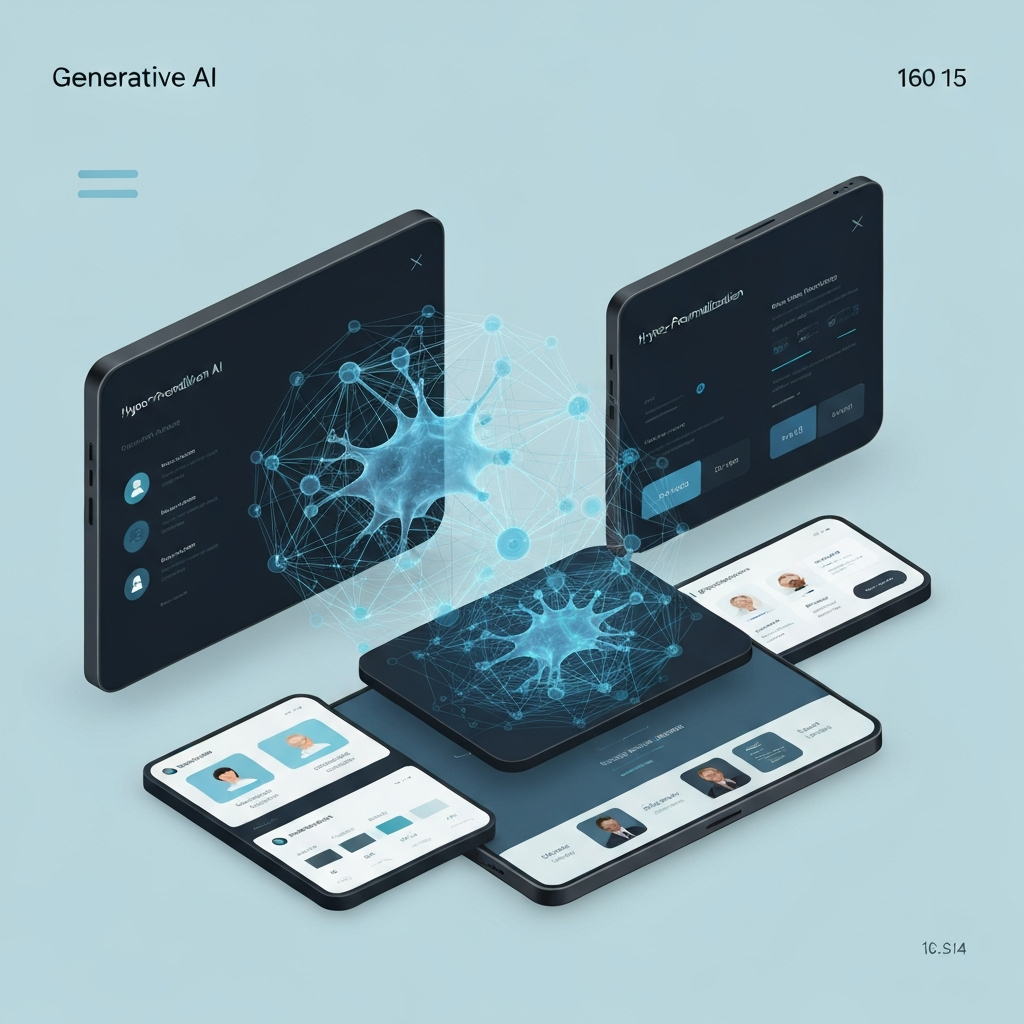
2. Applications of Generative AI for Hyper-Personalization
Generative AI is rapidly transforming various aspects of personalization, offering a wide range of applications across different industries. From crafting tailored marketing campaigns to creating dynamic product experiences, the possibilities are virtually endless. Let's explore some of the key applications of generative AI in hyper-personalization:
- Personalized Content Creation: Generative AI can create unique and engaging content tailored to individual users, including personalized blog posts, social media updates, email newsletters, and website copy. By analyzing user data and preferences, the AI can generate content that resonates with each individual, increasing engagement and driving conversions. For example, a news website could use generative AI to create personalized news feeds that highlight the topics and perspectives most relevant to each reader.
- Dynamic Product Experiences: Generative AI can be used to create dynamic product experiences that adapt to individual user needs and preferences. This includes personalized product recommendations, customized product configurations, and interactive product demos. For example, an online furniture retailer could use generative AI to create virtual room layouts that showcase how different pieces of furniture would look in a user's home. This personalized experience can significantly increase the likelihood of a purchase.
- AI-Powered Customer Service: Generative AI can power chatbots and virtual assistants that provide personalized customer service and support. These AI-powered agents can understand natural language, respond to customer inquiries, and resolve issues in real-time, providing a seamless and efficient customer experience. For example, a telecommunications company could use generative AI to create a chatbot that can troubleshoot technical issues, answer billing questions, and provide personalized recommendations for service upgrades.
3. Prompt Engineering for Personalized AI Interactions
Crafting effective prompts is crucial for unlocking the full potential of generative AI in personalization. A well-designed prompt can guide the AI to generate highly relevant and personalized content, while a poorly designed prompt can result in generic or irrelevant outputs.
Prompt engineering is the art and science of crafting effective prompts that guide generative AI models to produce the desired outputs. In the context of personalization, prompt engineering involves designing prompts that incorporate user-specific data and preferences to generate highly relevant and personalized content. This requires a deep understanding of both the AI model and the target audience. The quality of the output from a generative AI model is directly correlated to the quality of the prompt it receives, emphasizing the importance of well-crafted and targeted prompts for hyper-personalization.
To effectively utilize prompt engineering for personalization, start by gathering comprehensive data about your target users, including their demographics, interests, behaviors, and purchase history. Then, use this data to create personalized prompts that incorporate specific details about each user. For example, instead of using a generic prompt like "Write a product description," use a personalized prompt like "Write a product description for a waterproof hiking backpack, highlighting its durability and lightweight design, for a user who is interested in hiking and camping." Experiment with different prompt structures and phrasing to optimize the AI's output. Regularly evaluate the performance of your prompts and refine them based on user feedback and engagement metrics. Tools such as A/B testing can be useful for determining which prompts yield the best results with specific user segments.
By mastering the art of prompt engineering, you can unlock the full potential of generative AI in personalization. You can create highly relevant and personalized experiences that resonate with your target audience, increasing engagement, driving conversions, and building stronger customer relationships. Consider prompt engineering a continuous learning process, adapting to the evolving capabilities of AI models and the changing preferences of your users. The more precise and data-driven your prompts, the more impactful and personalized the AI's output will be.
🔗 Recommended Reading
Conclusion
Generative AI is poised to revolutionize the landscape of personalization, empowering businesses to create truly individualized experiences at scale. By leveraging the power of generative AI, companies can move beyond traditional rule-based personalization and deliver dynamic, adaptive, and highly relevant interactions across all touchpoints. This leads to increased customer engagement, higher conversion rates, and stronger brand loyalty, ultimately driving significant revenue growth. The ability to create unique content tailored to individual users, dynamic product experiences, and AI-powered customer service represents a paradigm shift in how businesses interact with their customers.
Looking ahead, the role of generative AI in personalization will only continue to grow. As AI models become more sophisticated and data availability increases, businesses will be able to create even more personalized and engaging experiences. The future of personalization lies in the ability to anticipate customer needs and deliver proactive, personalized solutions before they are even requested. Embracing generative AI and mastering the art of prompt engineering will be essential for businesses looking to thrive in the age of hyper-personalization, ultimately leading to increased customer satisfaction and a competitive advantage.
❓ Frequently Asked Questions (FAQ)
What are the ethical considerations of using generative AI for hyper-personalization?
Using generative AI for hyper-personalization raises several ethical concerns. One primary concern is data privacy; collecting and using vast amounts of personal data to train these AI models can potentially lead to privacy breaches if the data is not handled securely. Another ethical challenge is the risk of creating filter bubbles or echo chambers, where users are only exposed to information that confirms their existing beliefs, leading to polarization and a lack of exposure to diverse perspectives. Furthermore, there are concerns about potential bias in the AI models themselves, which can perpetuate and amplify existing societal biases if the training data is not carefully curated and monitored for fairness and accuracy.
How can businesses measure the effectiveness of generative AI-driven personalization?
Measuring the effectiveness of generative AI-driven personalization requires a multi-faceted approach that considers both quantitative and qualitative metrics. Key performance indicators (KPIs) such as click-through rates (CTR), conversion rates, and customer lifetime value (CLTV) can provide valuable insights into the impact of personalized content and experiences. A/B testing different personalization strategies is crucial for identifying what resonates best with specific user segments. Additionally, gathering customer feedback through surveys, reviews, and social media monitoring can provide qualitative data that helps businesses understand how customers perceive and respond to personalized interactions, enabling them to refine their strategies and improve overall customer satisfaction.
What are the limitations of using generative AI for hyper-personalization?
While generative AI offers significant potential for hyper-personalization, it's important to acknowledge its limitations. One limitation is the dependence on high-quality data; the accuracy and effectiveness of the AI models are directly correlated to the quality and completeness of the data they are trained on. Over-personalization can also be a concern, leading to a creepy or intrusive customer experience if the level of personalization is perceived as excessive or unwarranted. Additionally, the computational resources required to train and deploy generative AI models can be substantial, posing a barrier to entry for smaller businesses with limited budgets and technical expertise. Regular model maintenance and retraining are crucial to keep the AI up to date and mitigate the risk of generating irrelevant or outdated content.
Tags: #GenerativeAI #HyperPersonalization #AI #MachineLearning #PromptEngineering #ArtificialIntelligence #FutureTech