Here’s the surprising part: the vast majority of teams who fine-tune a model never needed to. A well-built prompt, paired with a few good examples, closes most of the gap that people assume only custom training can fix. I run content operations for a small team, and the number of times fine-tuning was the right call over the past year is a lot smaller than I expected going in.
That’s not an argument against fine-tuning. It’s a real tool with a real use case. But the decision gets made backwards constantly — people jump to retraining a model before they’ve pushed prompting anywhere near its actual ceiling. So let’s go through the myths that drive that decision, and what the reality looks like once you’ve tested both approaches on a real workload.
Myth: Fine-Tuning Produces Better Output Than Prompting
This one sounds intuitive. A model trained specifically on your data should outperform generic instructions fed to a general-purpose model, right?
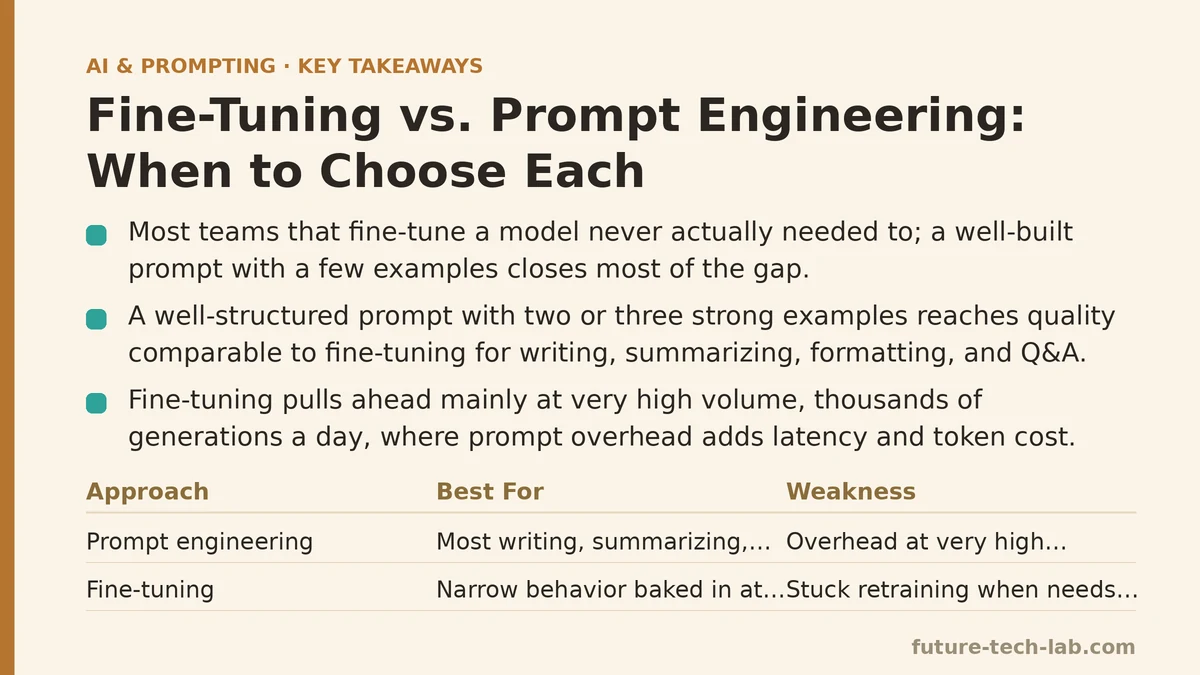
Reality: for the kind of work most teams do — writing, summarizing, formatting, answering questions against known material — a well-structured prompt with two or three strong examples gets you to comparable quality, often faster than a training run would. Fine-tuning shines when you need a narrow behavior baked in permanently, at scale, without repeating instructions every time. It doesn’t inherently produce smarter reasoning or better judgment. It produces a model that’s shaped to behave a certain way by default, which is a different thing than “better.”
You can test this directly with your own style guide. Instead of retraining anything, I fed the model five annotated examples of “on-brand” versus “off-brand” copy inside the prompt itself. Output quality matched what I’d been told to expect from a fine-tuned version, without the setup time.
Myth: Prompt Engineering Is Just a Temporary Fix Until You Fine-Tune
There’s an assumption floating around that prompting is the training-wheels phase, and every serious production system eventually graduates to a custom model.
Reality: plenty of mature, high-volume systems run entirely on prompting, indefinitely, because the underlying models keep improving and prompts are trivial to update when they do. Fine-tune a model on last year’s format requirements, and you’re stuck retraining every time your needs shift. A prompt is a text file you edit in five minutes. That flexibility matters more than people give it credit for, especially on a small team where nobody has a dedicated ML engineer on staff to manage retraining cycles.
It helps to update your prompts regularly as you learn what works. Retraining on that cadence would eat the entire team’s bandwidth.
Myth: Fine-Tuning Is the Only Path to Consistent Tone and Formatting
Consistency is usually the reason people cite when justifying a training investment. “We need every output to sound like us, every time.”
Reality: structured prompts with explicit formatting rules and a handful of worked examples close most of that gap. Give the model your voice guidelines directly, show it two or three passages that hit the mark, and specify exactly what to avoid. In our testing, this got tone-matching accuracy close enough to fine-tuned output that the difference wasn’t worth the setup cost. Where fine-tuning does pull ahead is at very high volume — thousands of generations a day — where even small prompt overhead adds up in latency and token cost. That’s a real advantage. It’s just a narrower one than “consistency” alone implies.
Myth: Fine-Tuning Is Cheap and Fast Now
Model providers have made the tooling around fine-tuning far more accessible than it used to be, and that’s led to a quiet assumption that it’s now a lightweight decision.
Reality: the training run itself might be quick. Everything around it rarely is. You need a clean, labeled dataset — usually hundreds of examples at minimum for anything reliable. You need to evaluate the result against a held-out test set, which means building an evaluation process you probably don’t already have. And you need a plan for what happens when the base model gets updated and your fine-tuned version becomes a fork you have to maintain separately. None of that shows up in the “five minutes to fine-tune” marketing. Budget for the data work and the evaluation work, not just the training job, or the cost estimate will be wrong by a wide margin.
Myth: It Has to Be One or the Other
This is probably the most persistent myth, and it’s the one that causes the most wasted debate internally.
Reality: the two approaches aren’t mutually exclusive, and the strongest setups combine them in sequence rather than picking a side. Prompt engineering is where you discover what “good” looks like — fast iteration, cheap experiments, immediate feedback. Once you’ve converged on a pattern that consistently works, and you’re running it at high enough volume that shorter prompts would meaningfully cut cost or latency, that’s the moment fine-tuning earns its cost. You’re not fine-tuning to discover the right behavior. You’re fine-tuning to lock in a behavior you already validated through prompting, so you can stop paying the token overhead of re-explaining it every time.
So When Does Fine-Tuning Actually Win?
Based on what’s held up in our own testing, fine-tuning is worth the investment when at least two of these apply:
- You’re running the same task at very high volume, and prompt length is a meaningful cost or latency factor.
- The behavior you need is narrow, stable, and unlikely to change soon — not something you’re still iterating on.
- You have, or can generate, a solid dataset of labeled examples, not just a handful of samples.
- Prompting has already gotten you close, and the remaining gap is small but consistent across every output.
If none of those apply yet, that’s usually a sign you’re still in the discovery phase, and prompting is the right tool for where you are.
What This Looks Like in Practice
In many setups, prompting handles nearly everything: drafts, summaries, formatting, first-pass edits. Fine-tuning shows up exactly once, for a classification task we run against thousands of inbound support tickets daily, where shaving prompt length actually reduced processing cost enough to matter. That’s one use case out of a dozen active workflows. The ratio might look different on a team with heavier, narrower, higher-volume needs — but the underlying logic stays the same either way: exhaust what a good prompt can do first, and let volume and stability tell you when it’s time to invest in something more permanent.
Related guides: Are AI Prompt Engineering Certifications Worth It? A 2025 Review, Common Prompt Engineering Mistakes and How to Fix Them, and Prompt Chaining vs. Single Prompts: When to Break Tasks Into Multiple Steps.
🔗 Recommended Reading
- How to Build a Semantic Search Engine with Embeddings: A Beginner's Step-by-Step Tutorial
- Building Your First RAG Chatbot: A Step-by-Step Tutorial for Beginners
- Function Calling for Beginners: A Step-by-Step Tutorial to Connecting LLMs to External APIs
- Vector Databases Explained: A Beginner's Guide to Storing and Querying Embeddings
- How to Evaluate LLM Outputs: A Beginner's Step-by-Step Tutorial to Testing and Scoring AI Responses