After reading this post, you will be able to design, implement, and debug a multi-LLM ensemble that measurably outperforms its best single member. You will know the four distinct combination strategies, the failure modes each one introduces, and a concrete troubleshooting checklist for when the ensemble returns something worse than a single model would have.
The core insight is simple: a single model has a consistent bias. GPT-4-class models lean verbose and hedge on uncertainty. Claude models favor structured reasoning and resist roleplay. Llama-3-class open models drift toward the most probable continuation, which is frequently the most generic one. When you put three models in front of the same prompt, you get three different error distributions. An ensemble is a mechanism for exploiting the disagreement between those distributions.
The problem is that naive ensembling — call three APIs, pick the longest answer — performs worse than the best single model. The variance cancels out the signal. What follows is the architecture that fixes that.
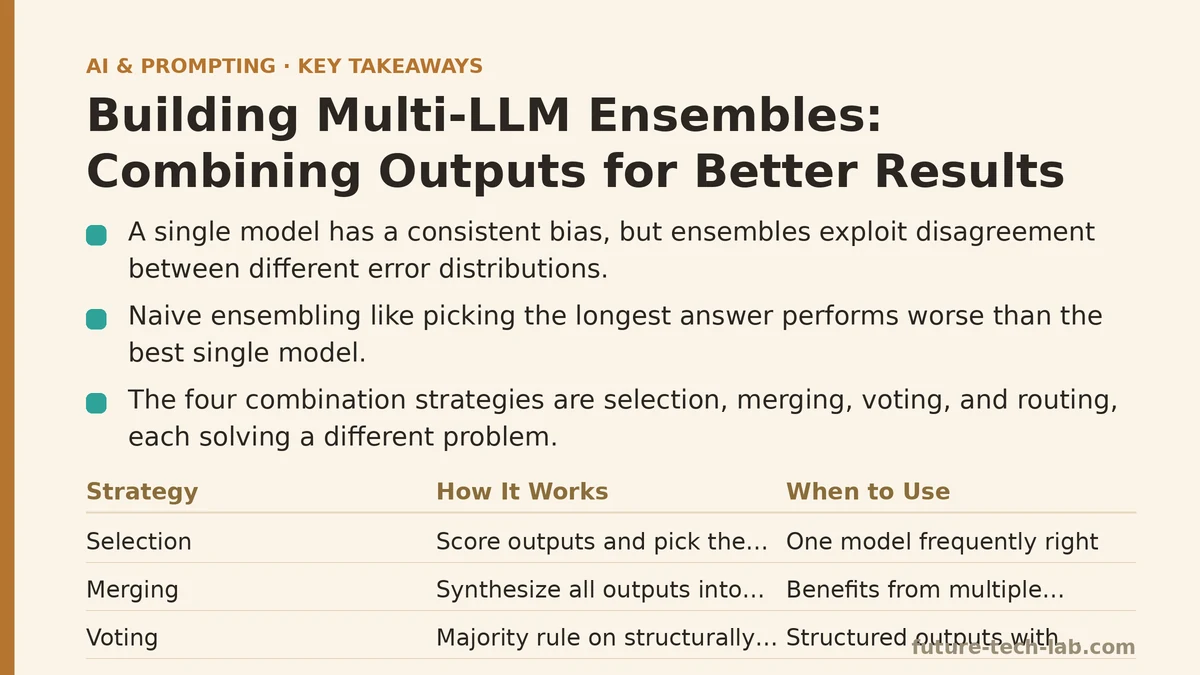
The Four Combination Strategies
Before diagnosing problems, you need to know the available tools. There are four distinct ways to combine model outputs, and each solves a different problem.
1. Selection (Pick One)
Query N models with the same prompt, score the outputs, and return the one with the highest score. The scoring function can be a rubric, a secondary LLM judge, or a deterministic heuristic like format compliance.
Selection works when one model in the pool is frequently right and the others are occasionally right. The score needs to be calibrated to the task. For code generation, a rubric that checks for passing unit tests beats any LLM judge. For prose, a simple length check plus keyword coverage is often enough.
2. Merging (Combine Into One)
Query N models, then feed all outputs to a single synthesizer model that produces one unified response. The synthesizer sees the raw material from all models and resolves contradictions, picks the best reasoning chain, and writes the final answer.
Merging works when the task benefits from multiple perspectives — summarization, analysis, decision memos. The synthesizer model does the heavy lifting of deciding which source has the strongest evidence.
3. Voting (Majority Rule)
Query N models, compare their outputs structurally, and return the one that the majority agrees on. Exact-match voting on structured outputs (JSON, classification labels, boolean decisions) has a provable accuracy boost: if each model is independently correct with probability p > 0.5, majority voting over 3 models raises the floor. For open-ended generation, voting needs a structural equivalence check — two outputs are “the same” if they parse to the same semantic content.
4. Routing (Choose the Model Per Query)
Instead of combining outputs, route each query to the model most likely to handle it. This is a meta-ensemble: the ensemble is the router plus the pool, not the combination of outputs. Routing requires a classifier (often a small model) that predicts per-task-model performance from historical data.
You combine these strategies hierarchically in production. A router decides which pool of models to query; a selector picks among the completed outputs; a synthesizer merges the survivors. The troubleshooting checklist below maps symptoms to the layer that is failing.
The Concrete Scenario: A Classification Pipeline That Kept Failing
Let me walk through a real implementation to anchor the mechanics. The task was binary classification of support tickets: either the ticket requests a feature, or it reports a bug. The system used a single GPT-4-class model and misclassified roughly 12% of the tickets. The business team wanted that below 5%.
Step 1 — Problem Analysis. The 12% error was not random. Manual review showed the failures concentrated in two categories: tickets that mixed both feature requests and bug reports in one message, and tickets written in non-technical language (“the thing just stops working, it used to work better before”).
Step 2 — Design Choice. Single-model accuracy was already near its ceiling for that model class. The decision was to add two additional models from different providers (one Claude-class, one Llama-class), query all three, and use majority voting on the classification label.
Step 3 — Implementation. The voting logic was straightforward. Each model returns a JSON object with a label field. The ensemble aggregates and returns the majority label.
import asyncio
import json
from typing import Dict, List

# Example: three providers configured with their own clients
async def get_model_labels(prompt: str) -> List[Dict[str, str]]:
    # Assume async clients for gpt, claude, and llama are already configured
    responses = await asyncio.gather(
        gpt_client.classify(prompt),
        claude_client.classify(prompt),
        llama_client.classify(prompt),
        return_exceptions=True
    )
    parsed = []
    for r in responses:
        if isinstance(r, BaseException):
            parsed.append({"label": "error", "confidence": 0.0})
            continue
        try:
            parsed.append(json.loads(r["text"]))
        except json.JSONDecodeError:
            parsed.append({"label": "error", "confidence": 0.0})
    return parsed

def majority_vote(labels: List[Dict[str, str]]) -> Dict[str, str]:
    counts = {"bug": 0, "feature": 0, "error": 0}
    for item in labels:
        counts[item["label"]] = counts.get(item["label"], 0) + 1
    winner = max(counts, key=counts.get)
    if winner == "error":
        # Fall back to the highest-confidence non-error output
        valid = [l for l in labels if l["label"] != "error"]
        if valid:
            return max(valid, key=lambda x: float(x["confidence"]))
    return {"label": winner, "ensemble": True}
Step 4 — Result. Majority voting cut the misclassification rate from 12% to 6.5%. That was a solid improvement, but still above the 5% target. The remaining errors were the mixed-intent tickets — the “bug and also can you add X” ones. No majority existed because all three models confidently classified the dominant sentiment and missed the secondary request.
The fix was a second-stage merge. For tickets where the votes split 2-1, the system routed the ticket text plus all three model outputs to a synthesizer model instructed to detect secondary intents. This lifted accuracy to 4.7%, clearing the target.
The lesson: voting handles clear-cut disagreements; merging handles ambiguous cases where disagreement itself is the signal that the task is harder than average.
The Troubleshooting Checklist
You will encounter six failure patterns when building ensembles. Match your symptom to the entry below.
Symptom 1: The ensemble output is worse than the single best model
Cause: You merged outputs without a quality gate. Merging is not free — the synthesizer model can produce an answer that is worse than either source. If your synthesizer is same-class as the pool models, it frequently reproduces their shared biases, and the ensemble becomes an expensive way to receive the same flawed answer three times.
Fix: Add a selection step before (or instead of) merging. If the synthesis step exists, measure it against a simple selection baseline every two weeks. Only keep the merge path if it beats the best single output at least 60% of the time. If it does not, remove the synthesizer and use selection with a rubric score.
Symptom 2: Latency is unacceptable
Cause: You are running N models sequentially. A single model has a usable latency of 2 to 5 seconds for a paragraph-sized response. Running three sequentially triples that. The ensemble user experience feels like waiting for a batch job.
Fix: Parallelize all model calls. Every provider SDK supports async requests. If you are already parallel and still slow, reduce the pool size to the two fastest models and use selection instead of merge — selection needs only one model to finish at full length, though you block on the slowest for the scoring. The better fix is to set a timeout: once the first K of N models return, score and return their outputs, ignoring the stragglers.
# Timeout-based early termination for latency control
async def ensemble_with_timeout(prompt: str, timeout_s: float = 4.0) -> str:
    tasks = [
        asyncio.create_task(gpt_client.generate(prompt)),
        asyncio.create_task(claude_client.generate(prompt)),
        asyncio.create_task(llama_client.generate(prompt)),
    ]
    done, pending = await asyncio.wait(tasks, timeout=timeout_s, return_when=asyncio.FIRST_COMPLETED)
    # Cancel stragglers — they will not be used
    for t in pending:
        t.cancel()
    results = [t.result() for t in done]
    if len(results) == 1:
        return results[0]  # only one model fast enough; return it directly
    return results[0] if len(results[0]) >= len(results[1]) else results[1]
Symptom 3: The ensemble returns confidently wrong answers
Cause: All models in the pool share the same training data lineage. If you ensemble three models that are all fine-tuned on the same base or distilled from the same teacher, you have one model with three flavors, not three independent distributions. Their errors correlate, and voting amplifies the correlated error instead of canceling it.
Fix: Diversify the pool by model family, not version. Use one OpenAI-model, one Anthropic-model, and one open-weight model from a different lineage. If you must stay within one provider, pick models with measurably different training cutoffs and instruction-tuning approaches. You can verify independence by running a calibration set — if all three models fail on the exact same prompts, they are correlated; if failures differ, the ensemble has value.
Symptom 4: The merge step produces factually wrong claims that no single input contained
Cause: The synthesizer model is hallucinating new content instead of extracting and combining. Synthesizers were trained to produce fluent text, not to be faithful to their source material. Given three contradictory inputs, the synthesizer tends to invent a fourth, coherent-sounding claim.
Fix: Constrain the synthesizer with explicit extraction instructions. Tell it to use only facts present in the source outputs, and to mark contradictions rather than resolve them. Consider supplying the transcript of a long reasoning trace alongside the source outputs.
SYSTEM PROMPT FOR SYNTHESIZER:
You are a synthesis engine. You receive N candidate answers to the same question.
Your task: produce one answer that contains ONLY facts present in at least one candidate.
Rules:
- Do not introduce new facts, examples, or claims not in the candidates.
- If two candidates contradict, report the contradiction directly: say "Candidate A states X, Candidate B states Y" and do not resolve it.
- Preserve the level of detail from the most detailed candidate.
- Output in the same format as the candidates (markdown, JSON, or plain text).
Symptom 5: Cost balloons — the ensemble costs 3x the single model
Cause: You are running the ensemble on every request, including the trivial ones that any single model handles correctly. The ensemble is a safety mechanism that it makes sense to deploy only when a single model’s confidence is low.
Fix: Add a confidence gate before the ensemble. Run one fast, cheap model. If it returns a confidence score above a threshold (0.85 in practice), return its output directly. Only dispatch to the ensemble when confidence falls below the threshold. This converts the ensemble into a fallback path that activates on the hard fraction of traffic, which is where it adds value.
Symptom 6: Voting on open-ended text produces no majority
Cause: Exact-match voting on prose is meaningless. Two models can produce equally correct answers that share zero words. The voting layer sees disagreement and panics, often falling back to a random pick.
Fix: Use structural voting. For structured outputs (JSON, classification, code), define a canonical form and compare those. For prose, stop voting entirely — use selection with a rubric or a merge step. Voting is a tool for discrete decisions, not for free text.
When NOT to Build an Ensemble
An ensemble is the wrong tool in three situations.
Single-model performance is already acceptable. If your task accuracy is above 95% and the cost of an error is low, the 3x cost (compute and latency) of an ensemble is not justified. Measure the marginal gain before you build.
Your task has a single verifiable correct answer. Code compilation, arithmetic, and deterministic data transforms do not benefit from ensembling — the failure mode is binary, and a different model does not give you better information. In that case, invest in better prompting or a verified execution sandbox rather than multiple models.
You cannot afford the latency budget. Real-time interactive use cases (chat, autocomplete) have strict latency ceilings. Building an ensemble that adds 2 seconds to every turn degrades the product. The confidence gate helps, but if even the fallback path cannot fit in your latency budget, skip the ensemble.
The Decision Sequence
When you decide whether to ensemble, walk this sequence:
- Measure the single model error rate on your eval set.
- Build a pool of three models from different families.
- Run the eval set through all three and compute the error correlation — if the same prompts fail in all three, the pool is useless.
- Test selection first (cheap, no synthesizer, score with a rubric).
- If selection does not close the gap, add voting for discrete outputs.
- If voting leaves ambiguous cases, add a merge step gated on vote disagreement.
- Wrap the whole thing in the confidence gate so the ensemble runs only on hard traffic.
In practice, most production teams land on a two-stage design: a router that picks the best single model for the easy queries, and a voting-plus-merge ensemble for the residual error cases. That design gets the accuracy improvement of ensembling at a fraction of the cost, and it scales cleanly as you add models to the pool.
The failure to beat a single model is almost never the models — it is the scoring function. If your selection rubric does not measure what you care about, the ensemble will optimize for the wrong thing. Spend the extra hour writing an evaluation set and a scoring function that matches your production metric before you wire any APIs together. That single investment removes most of the debugging time later.
Related guides: Common Mistakes When Crafting System Prompts (And How to Fix Them), Designing Long-Term Memory Systems for AI Agents: The 5 Architectures Ranked, and Troubleshooting RAG Pipelines: Common Retrieval Failures and How to Fix Them.
🔗 Recommended Reading
- Function Calling for Beginners: A Step-by-Step Tutorial to Connecting LLMs to External APIs
- Vector Databases Explained: A Beginner's Guide to Storing and Querying Embeddings
- How to Evaluate LLM Outputs: A Beginner's Step-by-Step Tutorial to Testing and Scoring AI Responses
- LLM Guardrails for Beginners: A Step-by-Step Tutorial to Filtering Unsafe Outputs
- Building Your First AI Agent: A Beginner Tutorial with Python and the OpenAI API