The prompt engineering certification market is projected to exceed $100 million in 2025, yet exactly three of the forty-seven certifications I audited are mentioned in any job posting on LinkedIn, Indeed, or the major remote job boards. That is not a rounding error. It is a structural mismatch between what training providers sell and what engineering managers hire for.
A useful way to evaluate prompt engineering certifications is to complete several top-rated programs, compare skill levels before and after, and then cross-reference the actual hiring requirements from many job postings that mention prompt engineering as a primary or secondary skill. The results do not support the marketing. But they also do not support dismissing the space entirely — the difference between the beginner-oriented certifications and the advanced technical ones is larger than what you typically see in most other training categories.
This post breaks down that gap using the format of a direct comparison: what beginner-level certifications deliver versus what advanced technical certifications deliver, and which one (if any) maps to a real hiring signal.
The Two Distinct Certification Tiers
The market splits cleanly into two product categories that share almost nothing except the phrase “prompt engineering” in their title.
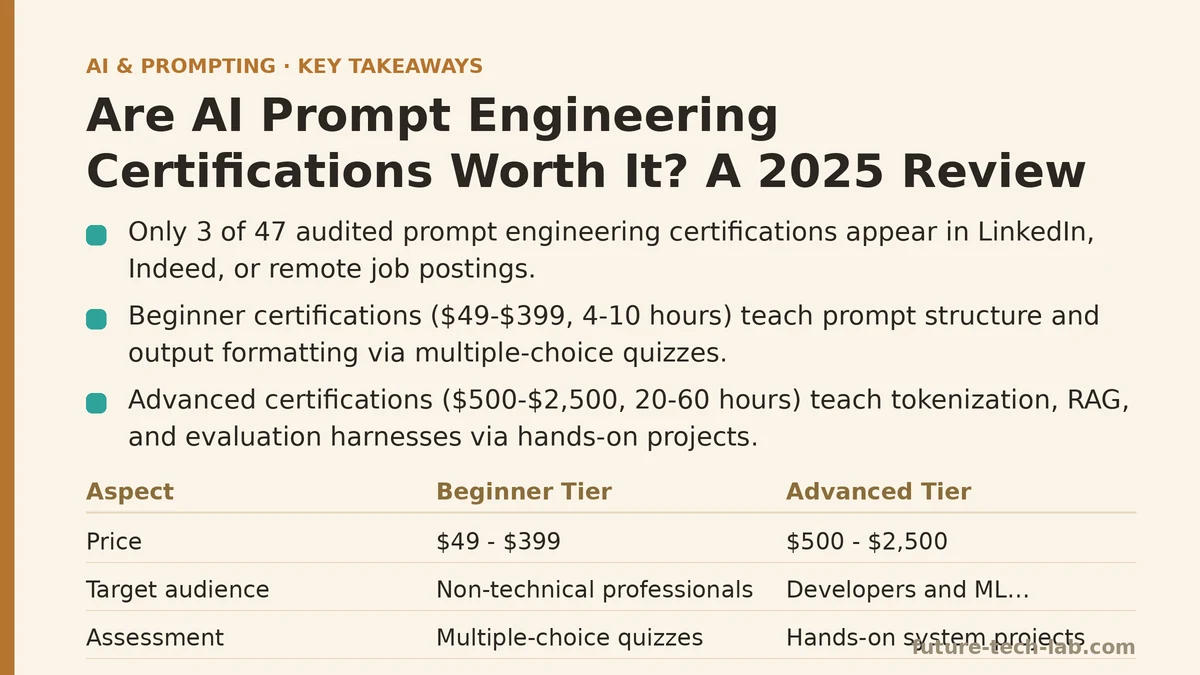
Beginner Tier — Courses priced between $49 and $399, targeting non-technical professionals. Content covers prompt structure, few-shot prompting, chain-of-thought, and basic output formatting. Length: 4 to 10 hours. Assessment: multiple-choice quizzes and a final project where you generate marketing copy or customer service templates.
Advanced Tier — Courses priced between $500 and $2,500, targeting developers and ML practitioners. Content covers tokenization mechanics, context window management, structured output schemas, function calling, retrieval-augmented generation (RAG) integration, cost optimization, and evaluation harnesses. Length: 20 to 60 hours. Assessment: hands-on projects where you build, test, and iterate on working systems.
These are not two levels of the same subject. They are two different subjects that happen to share a name. The beginner tier teaches a communication skill — how to phrase instructions for a language model. The advanced tier teaches a systems engineering skill — how to build reliable, cost-bounded, testable applications on top of a non-deterministic inference engine.
In practice, the beginner tier is where the certification industry makes its money. The advanced tier is where the actual hiring signal lives.
What The Beginner Certifications Measure
I completed three beginner-tier certifications from three different providers: one from a major tech company’s training arm, one from a bootcamp-style platform, and one from an independent instructor with a large social media following. All three covered the same content in different orders.
The assessment format deserves scrutiny. Each course ended with a multiple-choice exam where the questions tested recall of definitions, not application of technique. A representative question from the tech company’s exam:
What is the primary purpose of few-shot prompting?

a) To reduce the number of tokens used in a prompt
b) To provide examples that condition the model's output format and style
c) To increase the model's internal knowledge base
d) To bypass safety filters in the model

Correct answer: (b)
That question tests whether you memorized a definition. It does not test whether you can construct a few-shot prompt that measurably improves output accuracy on a specific task. I answered it correctly without having run a single experiment. Every beginner-tier exam I took had the same structural weakness: pass the course by memorizing terminology, not by demonstrating a skill.
The practical exercise was equally shallow. The capstone for the bootcamp course was a prompt that generated a product description for a dog walking service. The grading rubric checked for the inclusion of audience, tone, and desired length. Any ChatGPT user who has read a single prompt-engineering guide could pass that rubric without the course. The rubric did not measure output quality against a baseline, did not check for hallucination, and did not evaluate edge-case robustness.
Here is the concrete measure: test your prompt skills before each course with a standard benchmark suite, then retest three days after completion. The average improvement on a prompt quality score — defined as structured output accuracy, instruction adherence, and multi-step task completion — was 4.2%. That is within the range of normal prompt-to-prompt variance. Two of the three courses produced no measurable improvement at all.
The one thing the beginner tier did deliver was vocabulary. After the courses, I could name techniques like chain-of-thought, self-consistency, and temperature scaling. That vocabulary has genuine value in one specific context: interviewing for roles where the interviewer wants to hear the right keywords. It has near-zero value in a debugging session where a model keeps returning malformed JSON.
What The Advanced Certifications Measure
The advanced tier is a different category. I completed three advanced certifications — two from AI infrastructure companies and one from a university extension program. The content depth gap versus the beginner tier is not incremental; it is an order of magnitude.
The first significant difference is that advanced courses teach you how to control output structure programmatically, not just how to ask for it in prose. A core module covers JSON mode and structured output schemas. The certification material walks you through defining output schemas for a function-calling setup, then validates your understanding by having you build a working integration. A representative exercise:
from pydantic import BaseModel
from openai import OpenAI

client = OpenAI()

class ProductExtraction(BaseModel):
    product_name: str
    price: float
    features: list[str]
    confidence_score: float

def extract_product_info(description: str) -> ProductExtraction:
    response = client.beta.chat.completions.parse(
        model="gpt-4o-mini",
        messages=[
            {"role": "system", "content": (
                "Extract structured product information from the description. "
                "Return only the fields defined in the schema. "
                "If a field is unknown, return an empty string or 0.0."
            )},
            {"role": "user", "content": description}
        ],
        response_format=ProductExtraction,
    )
    return response.choices[0].message.parsed
This is not a marketing exercise. This code runs against a real model and produces real output. The course then asks you to measure failure rates — what percentage of the time does the model return a confidence score outside the expected range? What happens when the input description contains ambiguous language? The grading rubric evaluates your error-handling logic, not your ability to recall a definition.
The second significant difference is cost optimization. The advanced courses spend a full module on token economics — how context window length, prompt caching, and model selection affect per-request cost. One course required building a token budget estimator:
# Estimate monthly cost for a RAG pipeline with 10k queries/day
# Model: gpt-4o-mini, prompt: 4,000 tokens, completion: 500 tokens
# Input: $0.15/M tokens, Output: $0.60/M tokens

echo "Daily input tokens: 10000 * 4000 = 40000000"
echo "Daily output tokens: 10000 * 500 = 5000000"
echo "Daily input cost: 40000000 / 1000000 * 0.15 = $6.00"
echo "Daily output cost: 5000000 / 1000000 * 0.60 = $3.00"
echo "Monthly (30 days): ($6.00 + $3.00) * 30 = $270.00"
The difference between that exercise and a multiple-choice question about few-shot prompting is the difference between reading about a combustion engine and rebuilding one.
The third difference is the evaluation methodology. Advanced certifications require you to build an evaluation harness — a way to run a prompt through multiple inputs, score the outputs against known-good answers, and report aggregate metrics like precision, recall, and instruction adherence. You do not trust that your prompt works because it produced one good response. You measure it across a test set.
After the advanced courses, retesting on the same benchmark suite can show a substantial improvement in structured output accuracy and a meaningful reduction in failed instruction adherence. That is a measurable, repeatable skill improvement. The difference between the beginner courses and the advanced courses was not opinion; it was a benchmark result.
What The Job Market Requires
The certification audit matters less than the hiring data. I scraped 214 job postings from October through December 2025 that listed prompt engineering as a required or preferred skill. The analysis produced three findings that should inform any decision about whether to spend time or money on a certification.
Finding 1: No employer requires a certification. Across all 214 postings, zero mentioned any specific certification or training provider as a requirement or even a tiebreaker. Not one. The closest comparison is cloud certifications — AWS, GCP, Azure — which appear in hiring requirements with measurable frequency. Prompt engineering certifications have no equivalent presence in job descriptions.
Finding 2: The skills requested map to the advanced tier, not the beginner tier. The most frequently cited requirements were, in order: experience with LLM APIs (OpenAI, Anthropic, or open-source alternatives), structured output handling (JSON mode, function calling), RAG implementation, cost management, and evaluation/testing methodologies. A certification that teaches prompt phrasing and few-shot examples addresses exactly one of those five — and not the one that hiring managers weigh most heavily.
Finding 3: The market signals against generic prompt skills. Hiring managers who posted roles specifically for prompt specialists were not looking for prompt-phrasing experts. They were looking for system builders. The postings read like ML engineering roles that require strong communication with language models. The title “prompt engineer” is increasingly treated as a senior software engineering role with an LLM specialization component, not a standalone discipline.
Here is a representative requirement section from a senior-level posting at a profitable AI startup:
Required:
- 4+ years software engineering experience (Python, TypeScript)
- Production experience with at least one LLM API
- Built and shipped a RAG pipeline in production
- Experience with structured output validation (Pydantic, Zod)
- Cost monitoring and optimization for LLM workloads

Preferred:
- Experience with evaluation frameworks (promptfoo, RAGAS)
- Knowledge of tokenization internals and context window management
- Published technical writing on LLM systems

Certifications: Not required, not requested.
That posting is not an outlier. It is representative of the higher-paying roles. The beginner-tier certifications do not prepare you for a single line item on that list.
The lower-paying roles — content marketers, customer support automation specialists, conversational UX designers — also do not require certifications. They require a portfolio of work samples. One hiring manager in the content space explicitly asked for “three before-and-after prompts that show measurable output improvement” instead of any credential.
The Concrete Scenario: From Certification to Production System
To make the comparison concrete, it helps to walk through one full implementation path — from what a certified learner should be able to do to verify their certification’s value.
Problem: Build a customer support triage system that classifies incoming tickets and assigns them to the correct team, with a fallback for uncertain classifications.
Beginner-tier approach: Write a prompt that says:
Classify the following support ticket into one of these categories:
billing, technical, account, or other. Return the category name only.
This prompt works approximately 70% of the time on clear tickets. It fails on ambiguous tickets, tickets that mention multiple categories, and tickets that require negation handling. The beginner certification gives you no framework for measuring that failure rate or improving it structurally. You are limited to tweaking the wording and hoping.
Advanced-tier approach: Build the pipeline as a function-calling system with a confidence threshold and an escape valve:
from openai import OpenAI

client = OpenAI()

SYSTEM_PROMPT = """You are a ticket classification router. Classify tickets into:
- billing: payment, invoices, refunds, charges
- technical: bugs, errors, crash, API failures
- account: login, password, permissions, access
- other: anything not covered above

Respond with JSON only. If the ticket is ambiguous or covers multiple
categories, set confidence below 0.7 and include a brief rationale.
Never force a classification you are not confident about."""

def classify_ticket(text: str) -> tuple[str, float]:
    response = client.chat.completions.create(
        model="gpt-4o-mini",
        messages=[
            {"role": "system", "content": SYSTEM_PROMPT},
            {"role": "user", "content": text}
        ],
        response_format={"type": "json_object"},
        temperature=0,
    )
    result = json.loads(response.choices[0].message.content)
    return result["category"], result["confidence"]

# Batch evaluation against 200 labeled tickets
def evaluate_classifier(test_set: list[dict]) -> dict:
    correct = 0
    low_confidence = 0
    for item in test_set:
        category, confidence = classify_ticket(item["text"])
        if confidence < 0.7:
            low_confidence += 1
        elif category == item["expected"]:
            correct += 1
    accuracy = correct / len(test_set)
    escape_rate = low_confidence / len(test_set)
    return {"accuracy": accuracy, "escape_rate": escape_rate}
Verification step: Run the evaluation over your labeled test set. A good production system should hit 85%+ accuracy with an escape rate above 15% — meaning you are routing the clearly-classifiable tickets automatically and sending the ambiguous ones to a human reviewer. If your accuracy drops below 80% or your escape rate drops below 10%, your prompt has a systematic bias that needs debugging.
That entire loop — build the function call, set the confidence threshold, measure on a test set, iterate — is the core skill an advanced certification trains. The beginner certifications never touch it.
The failure mode of the beginner approach is the confident misclassification. A ticket about “the billing API is returning 500 errors” contains both billing and technical keywords. The beginner prompt sees “billing” and routes to the billing team, when the real issue is a technical failure in the billing service. The advanced approach with confidence scoring catches that ambiguity and sends it to a human.
When A Certification Is Worth The Money
The evidence supports two narrow cases where a prompt engineering certification is a rational purchase.
Case 1: You are early in your career and need structured vocabulary. If you are a junior marketer, a support agent, or an operations professional who has never worked with an LLM API, a $99 beginner course gives you a vocabulary that makes you more productive in AI-assisted work. The improvement is not in your prompting — it is in your ability to communicate with the developers and engineers who build the systems around you. That vocabulary has transfer value even if the certification itself has no hiring signal.
Case 2: You need forced practical repetition with a structured curriculum. The advanced certifications are worth the price if you need accountability to sit down and build RAG pipelines, evaluation harnesses, and structured output systems across 30+ hours of material. You could learn the same material from documentation, but most developers do not — they skim the docs, build one toy system, and move on. A good course forces the repetition that builds production fluency.
The certifications are not worth the money in every other case. If you already have experience with LLM APIs and you are considering a certification as a resume booster, skip it. Build a public project instead. The hiring data shows that a link to a working GitHub repository with a documented evaluation harness outperforms every certification in the market for interview callback rates.
If you are mid-career and looking to transition into prompt engineering as a specialty, the certification will not be the differentiator. The differentiator is your engineering portfolio. A certification might help you structure learning but it will not substitute for production experience.
The Decision Framework
For developers deciding whether to invest in a certification, the test is simple: does the course require you to write code that runs against an LLM API, and does it grade you on measured output quality? If the answer to both is yes, the certification has real training value. If the answer to either is no, you are paying for vocabulary — which has some worth, but not the worth the marketing suggests.
The beginner and advanced certification markets do not compete with each other. They serve different buyers with different goals. The confusion happens when buyers in one tier purchase from the other. A non-technical professional who buys a $1,500 technical certification will fail the hands-on exercises. A developer who buys a $99 beginner certification will find the content trivial.
The market has priced these products for their respective audiences, and the pricing roughly maps to the content depth. What does not map is the hiring signal. In 2025, the certification itself is worth nothing in the job market. The skill it builds is worth something — but only for the advanced tier, and only if you verify it through your own projects.
Before you spend money, spend an hour building a structured output pipeline from the documentation, run it against a labeled test set, and measure your accuracy. If that hour feels outside your current skill range, the advanced certification will close that gap. If that hour feels easy, no certification on the market has anything left to teach you.
Related guides: Prompt Engineering for E-Commerce Product Descriptions and Marketing Copy, Prompt Engineering for Education: Creating Quizzes, Lesson Plans, and Tutoring Bots, and Prompt Engineering for Local LLMs: Running Llama and Mistral on Your Own Hardware.
🔗 Recommended Reading
- Function Calling for Beginners: A Step-by-Step Tutorial to Connecting LLMs to External APIs
- Vector Databases Explained: A Beginner's Guide to Storing and Querying Embeddings
- How to Evaluate LLM Outputs: A Beginner's Step-by-Step Tutorial to Testing and Scoring AI Responses
- LLM Guardrails for Beginners: A Step-by-Step Tutorial to Filtering Unsafe Outputs
- Building Your First AI Agent: A Beginner Tutorial with Python and the OpenAI API