📖 5 min read
In the relentless battle against cybercrime, email security stands as a critical front line. While basic spam filters and antivirus software offer some protection, they often fall short against sophisticated attacks like phishing, business email compromise (BEC), and ransomware delivery. Advanced email threat detection employs cutting-edge techniques to identify and neutralize these evolving threats before they can impact an organization. This comprehensive guide delves into the inner workings of these advanced systems, exploring their methodologies and providing actionable insights for bolstering your email security defenses. Understanding these advanced techniques is crucial for any organization striving to maintain a robust security posture in today's threat landscape, where email remains a favored avenue for cybercriminals.
1. The Evolution of Email Threats
Email threats have evolved dramatically over the years. Early spam was largely a nuisance, but today's attacks are highly targeted, personalized, and financially motivated. Phishing attacks, for example, have become increasingly sophisticated, mimicking legitimate communications to trick users into divulging sensitive information. BEC attacks involve impersonating executives or trusted partners to manipulate employees into transferring funds or sharing confidential data. Ransomware is often delivered via malicious email attachments or links, encrypting critical systems and demanding payment for their release.
The rise of artificial intelligence (AI) and machine learning (ML) has further complicated the landscape. Cybercriminals are leveraging these technologies to automate attack campaigns, craft more convincing phishing emails, and evade traditional detection methods. For example, AI can be used to analyze communication patterns within an organization and create highly personalized phishing emails that are more likely to succeed. Malware developers are also using AI to create polymorphic malware that constantly changes its code to avoid detection by signature-based antivirus solutions. According to recent reports, AI-powered phishing attacks have seen a significant increase, demonstrating the growing sophistication of email threats.
The financial impact of these advanced email threats can be devastating. BEC attacks alone have resulted in billions of dollars in losses globally. Ransomware attacks can disrupt business operations, damage reputation, and lead to significant financial penalties. Beyond financial losses, data breaches resulting from email attacks can compromise sensitive customer information, leading to legal liabilities and reputational damage. Therefore, investing in advanced email threat detection is not just a security measure, but a crucial business imperative.
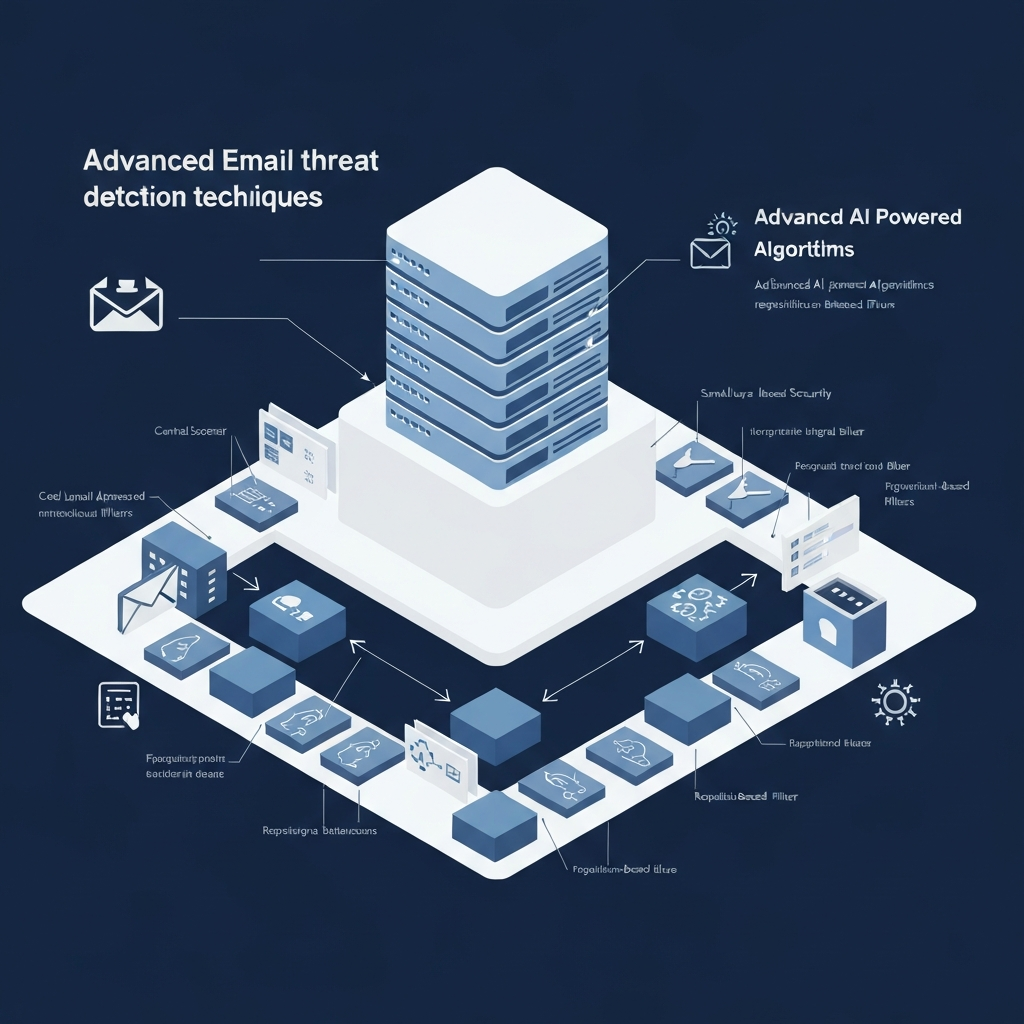
2. Key Technologies in Advanced Email Threat Detection
Advanced email threat detection relies on a multi-layered approach, incorporating several key technologies to provide comprehensive protection. These technologies work in concert to analyze email content, sender reputation, and user behavior, identifying and blocking malicious emails before they reach the inbox. This layered approach is essential because no single technology can effectively detect all types of email threats.
- Behavioral Analysis: This technique monitors user behavior patterns to identify anomalies that may indicate a compromised account or malicious activity. For example, if a user suddenly starts sending emails to recipients they have never communicated with before or accessing sensitive files outside of their normal working hours, it could be a sign of a compromised account. Behavioral analysis systems use machine learning algorithms to establish baseline behavior patterns for each user and flag any deviations from those patterns. This is a more proactive approach compared to reactive methods that rely on known signatures or blacklists, because it can identify threats that are not yet known.
- Sandboxing: Sandboxing involves executing suspicious email attachments or links in a isolated, secure environment to observe their behavior. This allows security analysts to identify malware or other malicious code without risking infection of the organization's network. The sandbox environment replicates a real-world user environment, allowing the malicious code to execute as it would on a user's machine. By observing the code's behavior, security analysts can determine if it is attempting to install malware, steal data, or perform other malicious activities. Sandboxing is particularly effective against zero-day exploits and advanced persistent threats (APTs).
- Threat Intelligence Feeds: These feeds provide up-to-date information on known malware, phishing campaigns, and other cyber threats. They aggregate data from various sources, including security vendors, research institutions, and government agencies. This information is then used to update email security systems with the latest threat intelligence, enabling them to proactively block known threats. Threat intelligence feeds can include information such as malicious IP addresses, domain names, URLs, and file hashes. By integrating threat intelligence feeds into their email security systems, organizations can significantly improve their ability to detect and prevent email attacks.
3. Implementing an Effective Email Threat Detection Strategy
Pro Tip: Regularly review and update your email security policies to reflect the evolving threat landscape and ensure that employees are aware of the latest threats and best practices.
Implementing an effective email threat detection strategy requires a holistic approach that encompasses technology, processes, and people. It's not enough to simply deploy advanced security technologies; organizations must also establish clear policies and procedures for handling email threats, and educate employees on how to identify and report suspicious emails. A successful strategy also involves continuous monitoring and analysis of email traffic to identify potential threats and vulnerabilities.
A key component of an effective strategy is employee training. Employees are often the first line of defense against email attacks, so it's crucial that they are able to recognize phishing emails, malicious attachments, and other suspicious activity. Training programs should cover topics such as identifying common phishing tactics, avoiding suspicious links, and reporting potential threats. Regular phishing simulations can also help to reinforce training and assess employee awareness. These simulations involve sending employees simulated phishing emails to see if they can identify and report them correctly. The results of these simulations can be used to identify areas where employees need additional training.
Regularly reviewing and updating your email security policies is also essential. The threat landscape is constantly evolving, so it's important to ensure that your policies reflect the latest threats and best practices. Policies should cover topics such as password security, acceptable use of email, and procedures for handling suspicious emails. They should also be regularly communicated to employees to ensure that they are aware of their responsibilities. The policies should also define the roles and responsibilities of different teams involved in email security, such as IT, security, and legal. Clear roles and responsibilities ensure that everyone knows what they are responsible for and helps to avoid confusion and delays in responding to email threats.
Conclusion
Advanced email threat detection is no longer an optional security measure, but a critical requirement for organizations of all sizes. As email threats continue to evolve and become more sophisticated, organizations must adopt a multi-layered approach that incorporates advanced technologies, robust policies, and comprehensive employee training. By proactively addressing email security risks, organizations can protect their data, reputation, and financial well-being.
The future of email threat detection will likely involve even greater reliance on AI and machine learning. These technologies will be used to automate threat detection, personalize security awareness training, and predict future attacks. Organizations that embrace these technologies will be better positioned to stay ahead of the evolving threat landscape and maintain a strong email security posture. Continuous adaptation and vigilance are essential in the ongoing battle against cybercrime.
❓ Frequently Asked Questions (FAQ)
What is the difference between basic spam filtering and advanced email threat detection?
Basic spam filtering relies on simple rules and blacklists to identify and block unwanted emails. These methods are often ineffective against sophisticated attacks that use advanced techniques to evade detection. Advanced email threat detection, on the other hand, uses a multi-layered approach that incorporates technologies such as behavioral analysis, sandboxing, and threat intelligence feeds to identify and block a wider range of email threats, including phishing, BEC, and ransomware. Advanced solutions are better suited for the complex and evolving threat landscape.
How can I measure the effectiveness of my email threat detection system?
Several metrics can be used to measure the effectiveness of your email threat detection system. These include the number of malicious emails blocked, the number of phishing emails reported by employees, and the time it takes to detect and respond to email threats. You can also use phishing simulations to assess employee awareness and identify areas where training is needed. Regularly monitoring these metrics and comparing them to industry benchmarks can help you identify areas where your email security system can be improved, ensuring that you are adequately protected.
What are the key considerations when choosing an email threat detection solution?
When choosing an email threat detection solution, it's important to consider several factors, including the size and complexity of your organization, the types of email threats you face, and your budget. You should also look for a solution that offers a comprehensive set of features, including behavioral analysis, sandboxing, and threat intelligence feeds. The solution should also be easy to manage and integrate with your existing security infrastructure. Furthermore, it is vital to ensure the vendor provides excellent customer support and regular updates to address emerging threats effectively.
Tags: #EmailSecurity #Cybersecurity #ThreatDetection #Phishing #Ransomware #BEC #AI